Tracing Light and Silence: A 5-Day Journey Through Tadao Ando’s Osaka & Awaji
A gentle architectural pilgrimage through concrete, light, water, and the quiet places that shaped Japan’s most poetic architect.
There are architects whose buildings you admire from afar—and then there is Tadao Ando, whose work you need to walk through, breathe in, and experience with your whole body.Concrete, yes.Geometry, of course.But above all: light, silence, water, and the gentle pulse of nature.
This 5-day itinerary takes you to the places where Ando’s story began and the landscapes where his imagination matured. It’s not rushed, it’s not checklist tourism—it’s a pilgrimage for the senses, written for curious travelers who want to understand the man behind the masterpieces.
Let’s begin where Ando began—Osaka.
DAY 1 — The Quiet Streets That Shaped a Legend: Sumiyoshi

If you want to understand Ando, don’t go straight to the churches or museums.Go to Sumiyoshi—a neighborhood of small homes, narrow lanes, and the kind of everyday beauty that most visitors overlook.
📍 Stop 1: Sumiyoshi Neighborhood (Ando’s Childhood Environment)
This district feels like a time capsule: wooden houses leaning toward each other, sunlight filtering through laundry lines, and the gentle quietness of an old Osaka morning.It was here that Ando learned about proportion not from theory but from life—how light falls inside tiny rooms, how materials age, how humans move through narrow spaces.
How to get there:Nankai Main Line → Sumiyoshi Taisha Station → walk 5 mins
📍 Stop 2: Sumiyoshi Taisha (住吉大社)
A few minutes’ walk away sits one of Japan’s oldest shrines.Bold vermilion gates. Clean geometry.A sacred calm that predates modern architecture by more than a thousand years.
Standing here, you begin to sense the roots of Ando’s spirituality:the timelessness, the minimal lines, the subtle dignity.
How to get there:Walk 10 mins from residential area.
DAY 2 — Concrete by the Sea: Osaka Culturarium & Harbor Walk
Today we follow Ando toward the sea—where concrete meets the horizon.

📍 Stop 1: Osaka Culturarium at Tempozan
A swirl of concrete facing the bay, this museum feels almost like a seashell.It’s Ando experimenting with curves, shadow, and movement—his early attempt at making public architecture as intimate as his houses.
Walk slowly.Let the building guide you.And watch how light wraps around its circular skin.
How to get there:Osaka Metro Chuo Line → Osakako Station → walk 5 mins.
📍 Stop 2: Tempozan Harbor Waterfront
After the intensity of concrete, the wide blue horizon feels like exhaling.This is where you watch ferries glide past and feel the salt wind on your face.The water softens everything.
The perfect complement to Ando’s disciplined geometry.
DAY 3 — A Beam of Sacred Light: Church of the Light (光の教会)
Today is the heart of your Ando pilgrimage.

📍 Stop 1: Church of the Light
You enter a dim concrete room.You turn the corner.And suddenly—there it is.
A perfect cross of pure white light slicing through the wall.
No ornament.No stained glass.Just light, space, and silence.
This building changed global architecture.People travel from every continent to stand in this room.
How to get there:JR or Hankyu → Ibaraki Station→ Bus 92/93 to Kasugaoka→ Walk 5 mins(Reservation required.)
📍 Stop 2: Ibaraki Neighborhood Walk
What makes the church so powerful is not just the light—it’s the contrast with the ordinary homes that surround it.
You walk through a normal Japanese suburb… and then you turn a corner, and there’s a masterpiece.That, too, is Ando’s philosophy.
DAY 4 — Rebirth on a Sacred Island: Yumebutai (夢舞台)
Awaji Island always feels a little magical—and Ando’s biggest project here is a story of healing.
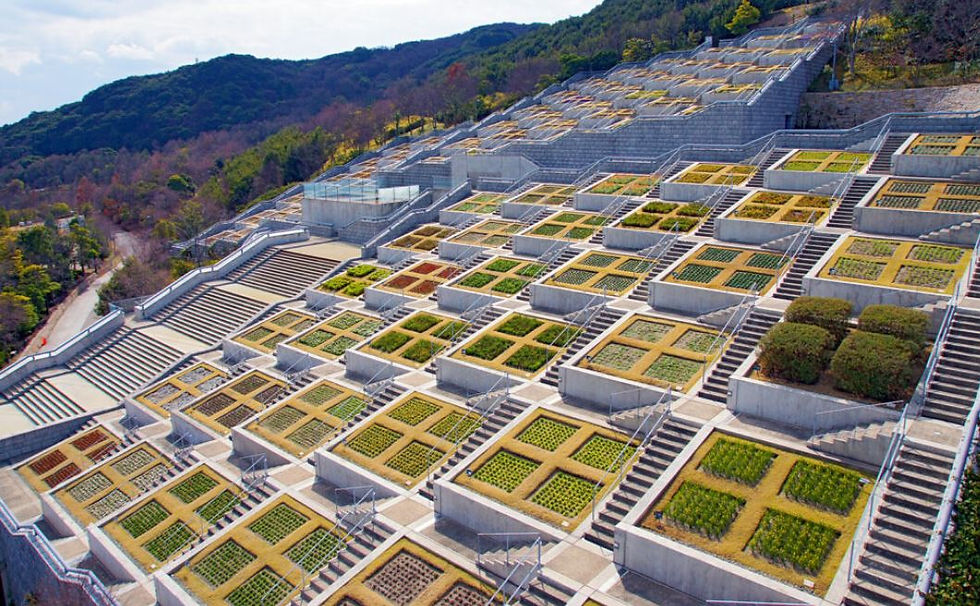
📍 Stop 1: Awaji Yumebutai
This vast complex rises from land once scarred by human excavation.After the 1995 Kobe earthquake, Ando turned this damaged hillside into a place of renewal:🌿 100 terraced gardens💧 Reflecting pools🌀 Curved pathways🌊 Ocean views tucked between concrete planes
It’s one of his most emotional works—architecture as environmental restoration.
How to get there:Osaka → JR to Maiko Station → Awaji Kotsu Bus → Yumebutai
DAY 5 — Into the Water, Into the Light: Water Temple & Hyogo Museum
The final day brings you two of Ando’s most meditative works.

📍 Stop 1: Water Temple (本福寺・水御堂)
One of Ando’s most breathtaking moments happens here:You arrive at a lotus pond.There is no visible building.Then you descend a circular pathway beneath the water—and step into a dim, crimson sanctuary carved from concrete.
This temple is light, water, and silence choreographed into one seamless experience.
How to get there:JR → Maiko Station → Awaji Bus → Higashiura → walk/taxi 7 mins
📍 Stop 2: Hyogo Prefectural Museum of Art
A waterfront museum designed after the Kobe Earthquake, dedicated to the city’s cultural rebirth.
It’s monumental but gentle—long terraces facing the sea, sculptural staircases catching the light, and a peaceful promenade that feels like a poem in concrete.
How to get there:Awaji Bus → Maiko StationJR → Nada Station → walk 10 mins
Sources & References (for Tadao Ando Blog Article)
Books & Monographs
Ando, Tadao. Tadao Ando: Complete Works. Phaidon Press.
Jodidio, Philip. Tadao Ando: Recent Projects. Rizzoli International Publications.
Dehli, Martin. Ando: Light and Architecture. Taschen.
Tadao Ando & Kenneth Frampton. Ando: The Colours of Light. Thames & Hudson.
Weston, Richard. Modernism: Architecture Since 1900. Laurence King Publishing.
Academic Articles / Journals
Frampton, Kenneth. “Critical Regionalism and the Architecture of Tadao Ando.” Architectural Review.
Botz-Bornstein, Thorsten. “Tadao Ando and the Metaphysics of Minimalism.” Journal of Aesthetics & Culture.
Kim, Jaeho. “Light as Material: Spatial Phenomenology in Tadao Ando’s Churches.” Journal of Architectural Theory.
Official Buildings & Museum Sources
Church of the Light (Ibaraki Kasugaoka Church) — Official information from the Ibaraki Kasugaoka Church website & visitor guidelines.
Honpukuji (Water Temple) — Official Honpukuji publications & Awaji tourism bureau.
Hyogo Prefectural Museum of Art — Official museum architecture page.
Awaji Yumebutai (Environment & Architecture Center) — Official Awaji Yumebutai site & Hyogo Prefecture tourism reports.
Osaka Culturarium at Tempozan — Osaka City cultural property archives.
Interviews & Primary Sources
Ando, Tadao. Various interviews in Japan Architect, GA Document, and Architectural Digest Japan.
“Conversations with Tadao Ando.” Harvard Graduate School of Design Lectures.
NHK Documentary Series: Professional: Tadao Ando Special Edition.
Urban & Cultural Context
Osaka City Urban Planning Publications: Sumiyoshi Ward historical development & urban fabric.
Awaji Island Tourism Bureau: historical notes on Yumebutai & post-earthquake reconstruction context.
Kobe Post-Earthquake Reconstruction Reports: background on Hyogo Prefectural Museum of Art.

Spannender Beitrag mit einer klaren und angenehmen Perspektive geschrieben. Gerade wenn man sich auch für digitale Angebote interessiert, ist Flagman Games Login ein interessantes Thema, das gut in solche Diskussionen passt. Ich freue mich schon auf weitere Beiträge mit ähnlichen Einblicken.
Reading this journey through Tadao Ando’s Osaka and Awaji really made me appreciate how light, water, and silence can transform a space. I remember last year trying to capture inspiration for my own architecture project while feeling buried under deadlines, and I ended up using dissertation help UK to manage my research and writing without losing focus. Experiencing Ando’s work reminds me that patience and careful attention to detail can turn even ordinary moments into something extraordinary.
I loved how the post walks through Tadao Ando’s Osaka Awaji journey with such poetic attention to light and quiet spaces, it almost felt like I was there absorbing the calm. It reminded me of a time during my stats classes when interpreting complex datasets felt just as daunting, and I turned to a Statistics Assignment Writing Service UK to help break down those concepts so I could focus on understanding rather than stressing. That support made the learning process feel more thoughtful and manageable.